

Live pro padel: lessons for mere mortals!
by Minter Dial

It’s a week since the inaugural London Premier Padel P1 came to an end with two outstanding finals at Olympia, confirming that professional padel has arrived in the UK in a serious way. Here our correspondent Minter Dial takes a look at the result and suggests what us mere mortals can learn from watching the pros.
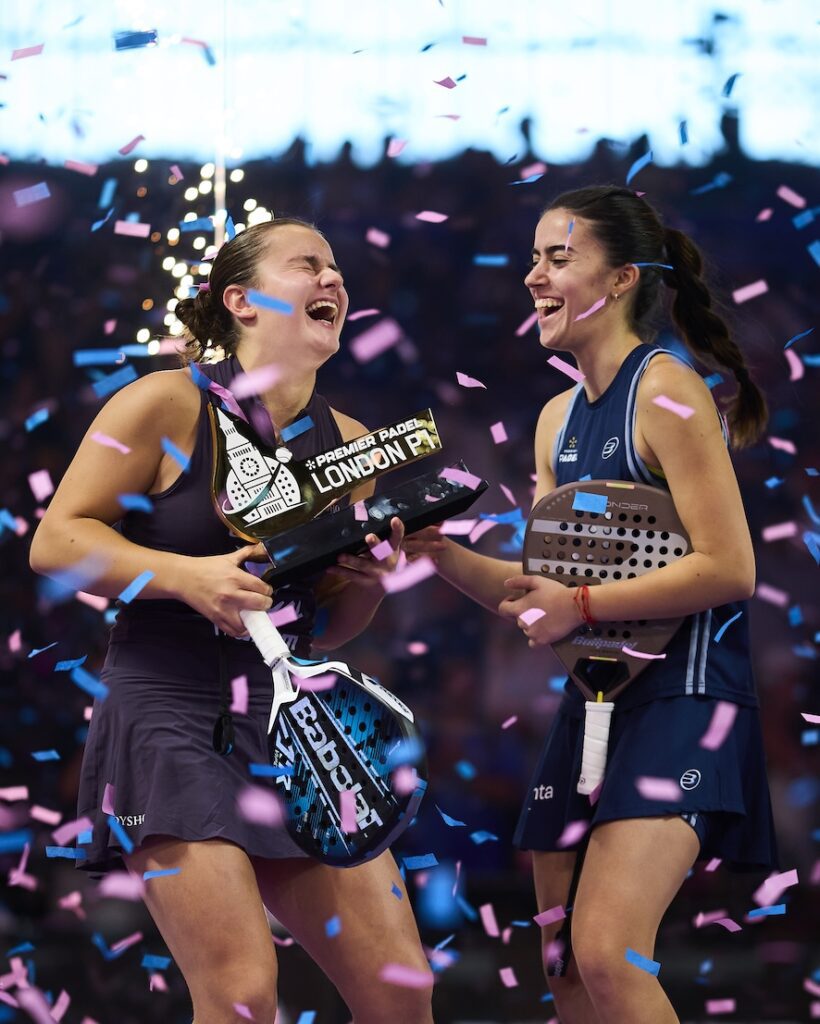
The women’s title went to fourth seeds Martina Calvo and Claudia Fernández, who defeated the world No 1 pair, Gemma Triay and Delfina Brea, 7–5, 6–3. It was the first title for Calvo and Fernández as a partnership—and a historic one: having turned 18 only a month earlier, Calvo became the youngest champion in Premier Padel history.
As a pair, Calvo and Fernandez also broke the record standing since 2017 for the youngest female duo ever to win a professional title (a combined 38 years and 205 days). In fact, they hold the record for both women and men; the youngest male duo ever was Arturo Coello (the ‘king’) and Agustín Tapia (the ‘magician’) winning the former World Padel Tour (WPT) 2023 Masters at Abu Dhabi at a combined age of 44 years and 207 days. (For the record, Coello is the youngest male to ever win a title, conquering the WPT event in Miami in 2022 (I was there), alongside the legendary Fernando Belastaguín, at the age of 19 years and 354 days).
Fernández, still only 20, and Calvo, 18, played with remarkable composure. After having narrowly won the first set, they raced to a 5–0 lead in the second set, then had to withstand a determined recovery from Triay and Brea before closing out the match. For all their youth, the pair showed a maturity well beyond their years and set Olympia alight with their achievement.
The women’s game was a delight to watch, absorb and learn from; the men’s game could feel like an advanced video game.
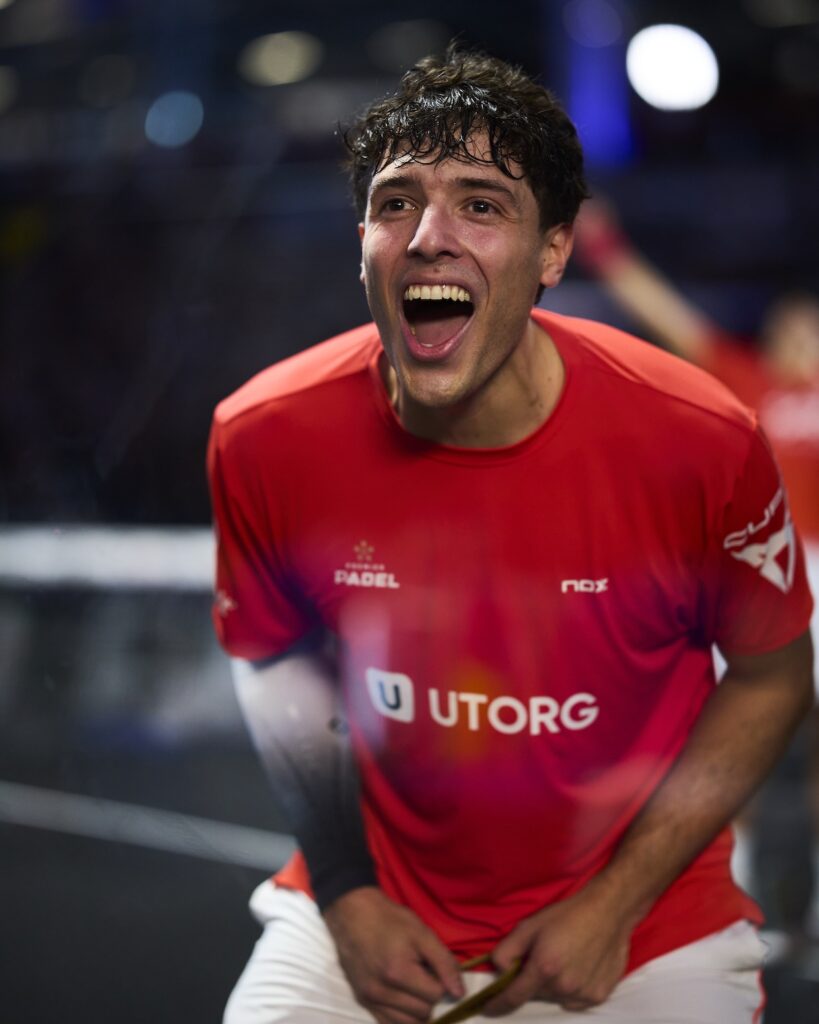
On the men’s side, top seeds Coello and Tapia once again got the better of second seeds Alejandro Galán (the ‘alien’) and Federico Chingotto (‘super mouse’), winning 6–3, 5–7, 7–5 in another instalment of padel’s great contemporary rivalry. Known affectionately by many fans as Chingalán, Galán and Chingotto fought back superbly after losing the first set. But Coello and Tapia found the extra gear when it mattered most, closing out a gripping third set to claim the first men’s London P1 title.
The victory was Coello and Tapia’s eighth title of 2026. It was also the fifth time in a row that they have triumphed over the number 2s. Of their 10 faceoffs against one another in the Premier Padel finals in 2026, the #1s have won six times against Chingalan’s four, with four of the brutal contests going to three sets. It was a nail-biter down to the end, and a magnificent display of skill, speed and force, as well as plenty of moments of good sportsmanship in spite of the fierce rivalry.
Two different masterclasses
The women’s final lasted 1 hour 45 minutes and featured 21 games. It was a compelling display of controlled aggression, defensive resilience and clarity under pressure. The men’s final lasted 1 hour 51 minutes and extended to 33 games. It was ferocious: enormous pace, athletic defence, lightning-fast exchanges at the net and extraordinary improvisation. As one friend put it, the women’s game was a delight to watch, absorb and learn from; the men’s game could feel like an advanced video game. Both are spectacular.
For club players hoping to learn from what they saw, the women’s game is generally the more accessible reference point. But that does not mean it is remotely easy.

Lessons for newer players
If you are early in your padel journey the professional game can feel distant. Yet there are three immediately useful lessons:
1: The wall is your friend. Notice how often elite players let the ball travel past them, allowing it to rebound off the glass rather than trying to force an awkward deep-court volley or half-volley. Learning to trust the walls gives you more time and more options.
2: Patience beats panic.Your first task is usually to keep the ball in play, not to hit a winner. Build points, use a generous margin over the net and make the opposition play one more ball. In club padel, many points are won simply by being the pair not making errors.
3: Prioritise enjoyment. My unofficial rule No 1 in padel is to have fun. If you do, you are far more likely to stay with the sport. Calvo made the point beautifully in her post-match press conference, when she spoke of trying to enjoy the occasion even while feeling the tension of being 5–0 ahead in a major final: “I think enjoyment is the key. It is very difficult when so many people are watching, you are in a final and you are 5–0 up, then suddenly they start coming back. It was difficult, but I tried to show calmness and tell myself ‘enjoy it’. I have enjoyed it a lot, and I think that is why I was able to play well.”
Lessons for intermediate players
For players around Playtomic levels 3 to 5, three patterns repeatedly stand out when watching the pros:
1 Use the lob as an attacking tool. A substantial share (c 30%) of shots played from the back of the court are lobs. In padel, unlike in tennis, the lob is often an offensive shot: it pushes opponents away from the net and gives you the chance to advance. Watch how precisely the best players place their lobs, often deep around or beyond the service line. And when you deliver a good lob, run up to the net to try to block their return.
2 Communicate constantly. The chatter between professional partners is striking, especially when you sit court side. They call balls going out, identify opponents’ positions, suggest where to hit the ball, agree on tactics and keep each other emotionally steady. If you and your partner are not communicating, you are missing a major tactical advantage.
3 Fight to earn the net. The pair at the net generally has the initiative and wins a large majority of points. The challenge is not merely getting forward, but doing so intelligently; with a good lob, a deft chiquita to the feet, or a controlled ball through the middle that creates an opening.
Lessons for advanced players
For those above level 5, the learnings become more nuanced:
1 Watch the feet. Footwork is not decorative; it creates options. Players such as Chingotto, Yanguas and Ortega are constantly adjusting their position, staying balanced and preparing early. Their footwork gives them options to play several different shots with the same ball, helping to introduce disguise.
2 Stay low on balls off the back wall. When volleyed balls travel deep and low off the back wall, bend down to get your wrist and racquet head beneath them, open the racquet face and focus first on clearing the net. Depending on the ball and the opponents’ position, the defensive lob can be the right choice.
3. Treat transition as fluid. Padel is not simply a choice between defending at the back and attacking at the net. The best pairs move forwards and backwards as the point demands. Press when the opportunity is there but do not force the transition before you have earned it. You may also see that players like Galán and explosive Leo Augsberger will often just stay at the net, even when his partner is back fielding the ball. But that requires an awesome reaction speed, so only for those who qualify!
Differences you cannot see
The decisive gap between pros and the rest of the padel world lies in three less visible areas:
1: Decision-making: knowing when to accelerate, when to defend and when to build the point patiently.
2: Physicality: fitness, balance, footwork, explosive movement and the ability to reproduce the shots with consistency late in a match.
3: Mental strength: trusting your partner, forgetting mistakes and maintaining belief under pressure.
Why live padel matters
If you have not yet watched professional padel live, you are missing a trick. London P1 offered the atmosphere, community, entertainment and drama that the sport needs to take another step forward in the UK. The event brought thousands of spectators to Olympia, while Calvo and Fernández’s breakthrough and another Coello–Tapia triumph gave the inaugural tournament real sporting weight. As Kellie Johnson, of Smash Padel, observed in her LinkedIn post, the conversation has changed: people who barely followed the professional game a week earlier now know the players, have favourites and are invested in the rivalries and personalities around the sport. That shift matters. Padel is no longer only something we play; increasingly, it is something we follow.
Ready for some more pro padel? Check out Premier Padel’s channel on YouTube or RedBull TV.