

Health: dealing with shoulder impingement
By Wesley Teixeira, MCSP BSc, Sports Physiotherapist and founder of BAS3LINE
Following on from the article ‘The Unseen Opponent: Tackling Shoulder Pain in Padel’ in The Bandeja padel magazine (read here), this guide provides a detailed, practical plan to spot the early signs of shoulder impingement. It includes a series of exercises, stretches, and general tips to treat and, most importantly, prevent these rotator cuff issues from keeping you off the court.
Spotting the early signs of shoulder impingement
Shoulder impingement, or subacromial pain syndrome, is a common ailment in padel due to the repetitive overhead motions of the sport. Recognising the early signs is crucial for preventing more severe injuries. Common signs to look for include:
• Pain: A dull ache or sharp pain at the front or top of the shoulder, which may radiate down the side of the arm. The pain often worsens with overhead activities or at night, making it difficult to sleep on the affected side. [1]
• Weakness: A noticeable lack of power during shots, especially smashes and serves. You might experience a ‘dead arm’ feeling after playing. [2]
• Stiffness: A loss of motion in the shoulder, making everyday activities like putting on a jacket or reaching for high shelves a challenge. [3]
Self-assessment tests
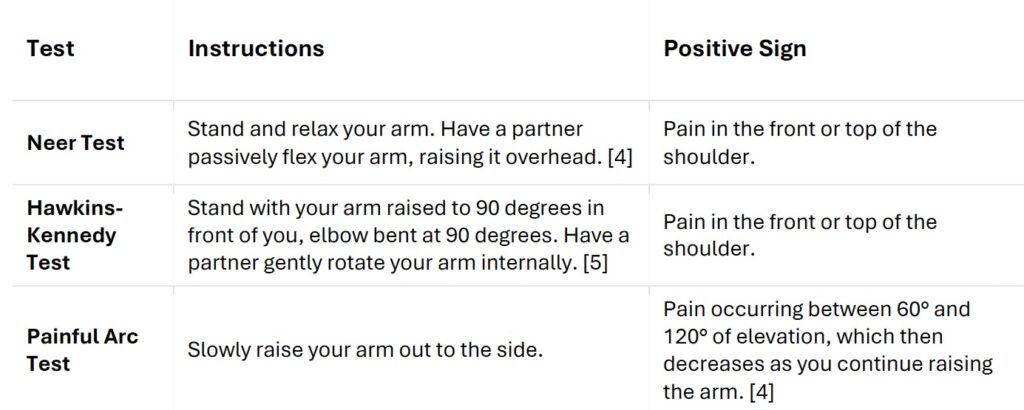
While a formal diagnosis should be made by a healthcare professional, these simple tests can help you identify a potential impingement issue. If you experience pain during any of these tests, it is advisable to consult a doctor or physical therapist.
Treatment and prevention plan
The key to both treating and preventing shoulder impingement is to address the underlying muscular imbalances. This involves a combination of stretching tight muscles and strengthening weak ones.
Stretching exercises
These stretches should be performed daily to improve flexibility and reduce tightness in the shoulder joint and surrounding muscles. Hold each stretch for 30 seconds and repeat 3-4 times.
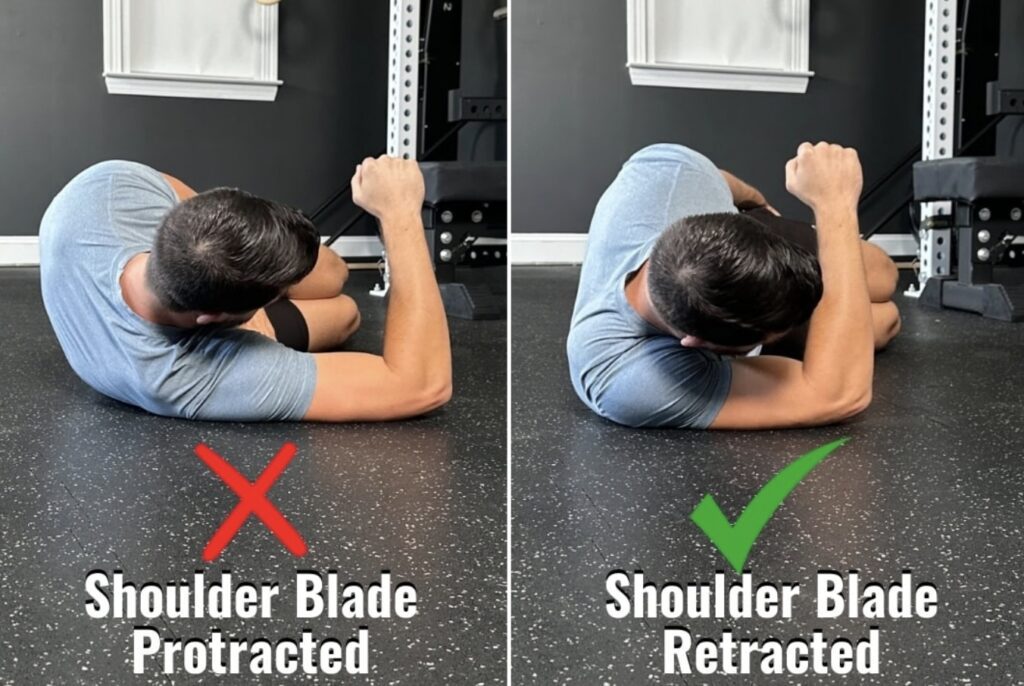
Sleeper stretch [6]: this stretch targets the posterior capsule of the shoulder, which is often tight in overhead athletes:
2: Use your other hand to gently push your forearm down towards the floor.
3: Stop when you feel a stretch in the back of your shoulder.
Doorway pectoral stretch [7]: this stretch helps to open up the chest and stretch the pectoral muscles, which can become tight and dominant in padel players:
1: Stand in a doorway and place your forearms on the frame, with your elbows slightly above shoulder height.
2: Step forward with one foot until you feel a stretch in your chest and the front of your shoulders.
Cross-Body Stretch [8]: this stretch also targets the posterior shoulder capsule and helps to improve internal rotation.
1: Bring one arm across your body at shoulder height.
2: Use your other hand to gently pull the arm closer to your chest.
3: Hold the stretch, feeling it in the back of your shoulder.
Strengthening exercises
These exercises are designed to strengthen the rotator cuff and the muscles that stabilise the scapula (shoulder blade). Perform these exercises 3-4 times per week, starting with light weights or resistance bands and gradually increasing as you get stronger.
Side-lying external rotation [9]: this exercise isolates and strengthens the external rotators of the shoulder.
1: Lie on your side with a small towel roll under your armpit.
2: Keep your elbow bent at 90° and resting on your side.
3: Slowly rotate your arm upwards, lifting a light dumbbell.
4: Lower the weight with control.
5: Perform three sets of 10-15 repetitions.
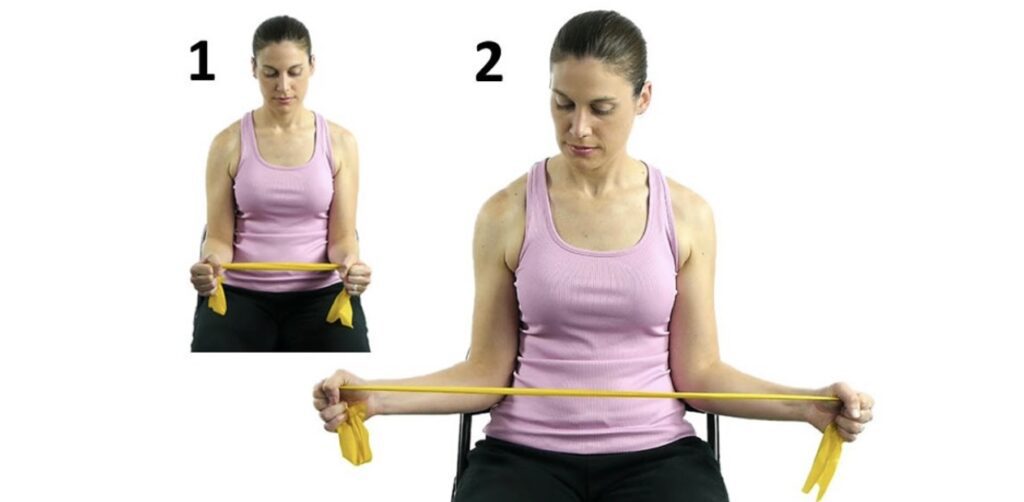
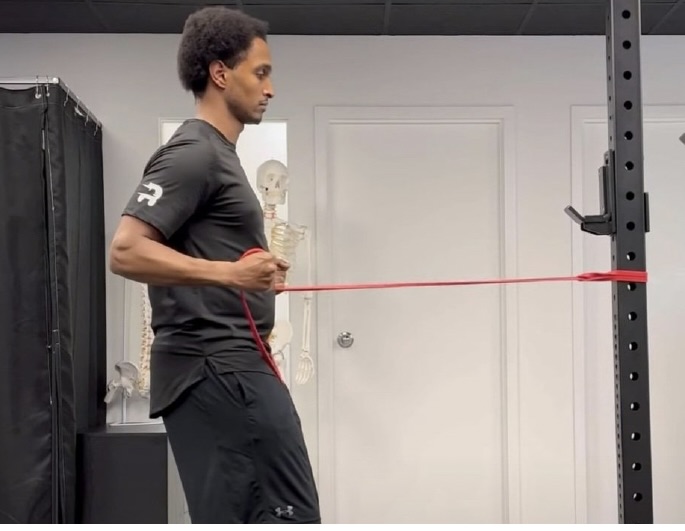
Standing external rotation with resistance band [9], another excellent exercise for strengthening the external rotators:
1: Stand with a resistance band anchored at waist height.
2: Hold the band with your elbow bent at 90° and close to your side.
3: Rotate your arm outwards against the resistance of the band.
4: Return to the starting position slowly.
5: Perform three sets of 10-15 repetitions.
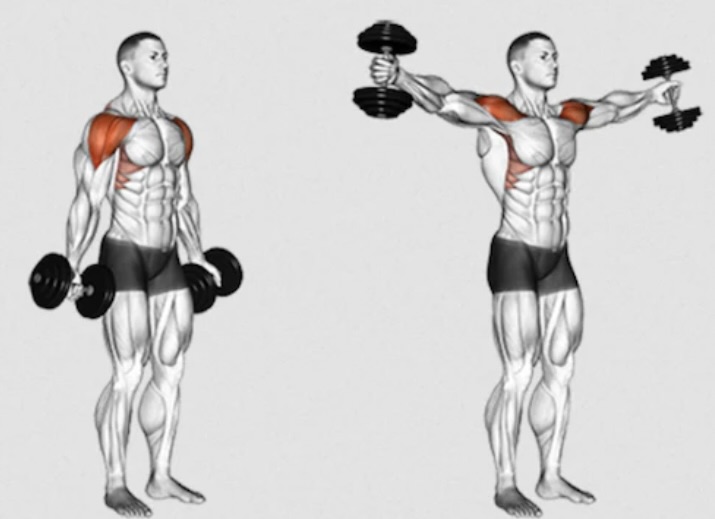
Shoulder scaption [9]: this exercise strengthens the supraspinatus muscle of the rotator cuff and the deltoids.
1: Stand with your feet shoulder-width apart, holding light dumbbells.
2 Raise your arms to shoulder height at a 45° angle from your body, with your thumbs pointing up.
3: Lower the weights slowly.
4: Perform three sets of 10-15 repetitions.
Standing row with resistance band [8]: this exercise strengthens the scapular stabilizers, which are crucial for proper shoulder mechanics.
1: Anchor a resistance band in front of you at chest height.
2: Hold the band with both hands and pull it towards your chest, squeezing your shoulder blades together.
3: Return to the starting position with control.
4: Perform three sets of 10-15 repetitions.
General tips for prevention
• Warm-up: always warm up for at least 10-15 minutes before playing padel. This
should include light cardio and dynamic stretches.
• Cool-down: after playing, perform static stretches, holding each stretch for 30 seconds.
• Proper technique: work with a coach to ensure you are using proper form for your shots, especially the smash and bandeja.
• Listen to your body: If you feel pain, don’t push through it. Rest and ice the affected area.
• Cross-training: incorporate other forms of exercise into your routine to maintain overall fitness and prevent muscle imbalances.
By following this comprehensive plan, you can effectively spot the early signs of shoulder impingement, treat existing issues, and prevent future problems. 🎾
References
[1] Cleveland Clinic. (2025, September 11). Shoulder Impingement Syndrome (Rotator Cuff Tendinitis). Retrieved from https://my.clevelandclinic.org/health/diseases/shoulder-impingement-rotator-cufftendinitis
[2] Creech, J. A., & Silver, S. (2023). Shoulder Impingement Syndrome. In StatPearls. StatPearls Publishing. Retrieved from https://www.ncbi.nlm.nih.gov/books/NBK554518/
[3] Woodward, T. W., & Best, T. M. (2000). The Painful Shoulder: Part I. Clinical Evaluation. American Family Physician, 61(10), 3079–3088. Retrieved from https://www.aafp.org/pubs/afp/issues/2000/0515/p3079.html
[4] Medbridge. (n.d.). 10 Essential Tests for Evaluating for Shoulder Impingement. Retrieved from https://www.medbridge.com/blog/10-essential-tests-for-evaluating-for-shoulder-impingement
[5] Physio-pedia. (n.d.). Hawkins / Kennedy Impingement Test of the Shoulder.
Retrieved from https://www.physiopedia.com/Hawkins_/_Kennedy_Impingement_Test_of_the_Shoulder
[6] Cools, A. M., Johansson, F. R., Borms, D., & Maenhout, A. (2015). Prevention of shoulder injuries in overhead athletes: a science-based approach. Brazilian journal of physical therapy, 19(5), 331–339. https://doi.org/10.1590/bjpt-rbf.2014.0109
[7] ACE Fitness. (2023, October 27). 5 Chest Stretch Variations to Improve Flexibility.
Retrieved from https://www.acefitness.org/resources/everyone/blog/5657/5-cheststretch-variations/
[8] OrthoInfo. (n.d.). Rotator Cuff and Shoulder Conditioning Program. Retrieved from https://orthoinfo.aaos.org/en/recovery/rotator-cuff-and-shoulder-conditioningprogram/
[9] HSS. (2023, April 3). Exercises for Shoulder Impingement, from a PT. Retrieved from https://www.hss.edu/health-library/move-better/exercises-shoulder-impingement